
Milwaukee Precision Casting
Investment Casting for Solar Energy Applications
Solar energy infrastructure demands precision-manufactured components that perform without failure across decades of outdoor operation. Solar tracker systems, mounting structures, and gearbox assemblies are subject to continuous mechanical stress, temperature cycling, and environmental exposure. All of these are conditions that require the dimensional accuracy, material integrity, and repeatable quality that investment casting delivers.
Milwaukee Precision Casting, Inc. (MPC) produces investment castings for solar energy applications from our Milwaukee, Wisconsin facility. We are ISO 9001:2015 certified, ITAR registered, and cast a wide range of alloys suited to the performance requirements of solar infrastructure, including non-magnetic stainless steel for tracker systems and carbon steel for structural hardware.
Why Choose Investment Casting?
Why Investment Casting for Solar Applications?
Solar energy systems are designed to operate with minimal maintenance for 25 to 35 years. The mechanical components within tracker systems, gearboxes, and mounting assemblies must hold tight dimensional tolerances throughout that service life without play, premature wear, or corrosion-driven failure.
Investment casting is the preferred manufacturing process for these components because it combines near-net shape accuracy, material flexibility, and high repeatability in a single production step. Key advantages for our solar buyers include:

Tight dimensional tolerances (±0.005 in/in) reduce post-cast machining and ensure consistent part-to-part fit across high-volume production runs.
A wide range of castable alloys allows MPC to match the material to the environment. For example, non-magnetic stainless steel for tracker systems, carbon steel for structural hardware, and specialty alloys for high-corrosion coastal applications.
Near-net shape output minimizes material waste and reduces machining operations required before installation.
Prototype and low-volume runs are available using 3D-printed wax patterns, allowing component validation before committing to full production tooling.
Complex geometry, including undercuts, internal channels, and close-tolerance bearing surfaces, is achievable in a single cast, eliminating weldments and reducing assembly cost.
Why Choose Investment Casting?
Solar Investment Casting Components
MPC produces investment castings for four primary application areas within the solar energy sector. Each component category demands specific alloy properties, tolerance requirements, and surface characteristics that investment casting is uniquely suited to provide.
Solar Tracker Components
Single-axis and dual-axis solar trackers are the most mechanically demanding component systems in a solar installation. Tracker systems continuously adjust panel orientation to follow the sun, placing cyclic mechanical loads on every pin, shaft, bushing, and drive component. These parts must maintain dimensional integrity under load while resisting corrosion and wear over the service life of the installation.
MPC casts the following tracker components to investment casting tolerances of ±0.005 in/in:
- Tracker pins: Load-bearing pivot points connecting tracker arms to the torque tube and foundation structure. Cast in non-magnetic 316 stainless steel to eliminate interference with encoder and sensor systems.
- Tracker shafts: Rotating members that transmit drive force through the tracker system. Tight roundness and straightness tolerances are maintained as-cast, reducing grinding and finishing requirements.
- Bushings and bearing housings: Wear-critical interfaces between rotating and static members. Cast to close tolerances in corrosion-resistant alloys, with smooth as-cast bore surfaces achievable to 125 RMS.
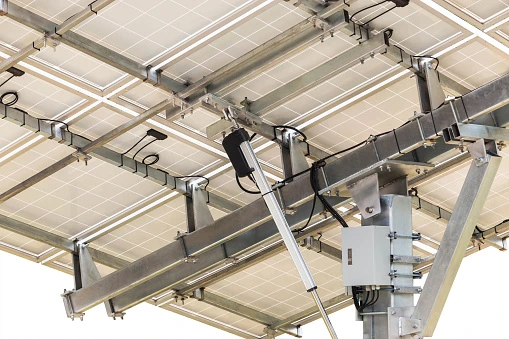
Mounting System Hardware
Mounting systems secure solar panels and tracker assemblies to the foundation structure. Hardware components must carry substantial static and dynamic loads, including wind, snow, and seismic forces, while maintaining dimensional stability and corrosion resistance throughout the project life.
MPC produces mounting hardware including:
- Clamps and saddles that secure panels and rails to the racking structure.
- Splice connectors and torque tube end caps for single-axis tracker rail systems.
- Foundation anchor brackets and pile cap connectors for ground-mount and ballasted systems.
- Adjustable tilt hardware for fixed-tilt systems in both landscape and portrait orientations.
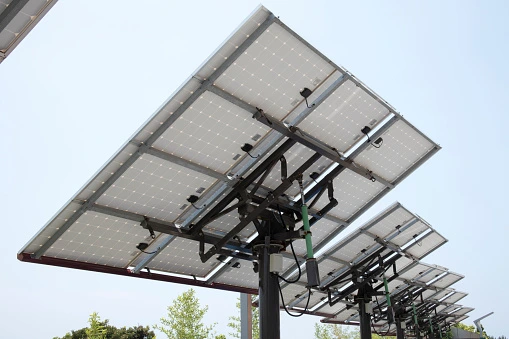
Structural Connectors
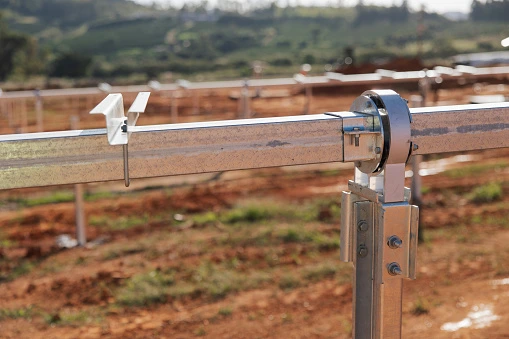
Structural connectors join the primary load-bearing members of ground-mount and roof-mount solar arrays. These components must be dimensionally consistent across large production quantities to ensure field installation efficiency and structural compliance across the full array.
MPC casts structural connectors in carbon steel, stainless steel, and other alloys specified by the system designer. Investment casting allows complex connector geometry, including multi-directional bolt holes, gussets, and bearing surfaces, to be produced in a single operation without welding or secondary fabrication.
Gearbox and Drive Components
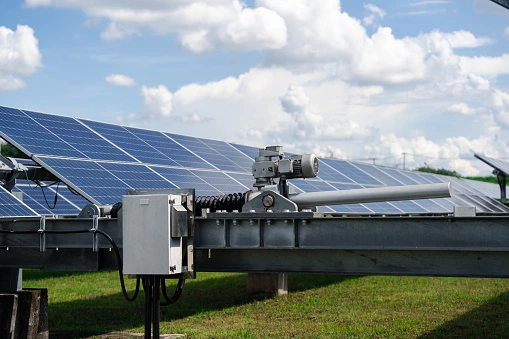
The drive system that rotates a solar tracker is the highest-wear subsystem in the installation. Gearbox components including housings, gear blanks, output flanges, and drive shafts require close tolerances, good surface integrity, and alloys with appropriate hardness and fatigue resistance.
Investment casting is well suited to gearbox components that require complex external geometry combined with machined bores and surfaces. MPC casts gearbox housings and drive components and can coordinate secondary CNC machining operations as part of a full-service supply arrangement.
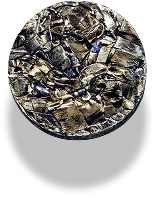
316 Stainless Steel (non-magnetic)
Primary alloy for tracker pins, shafts, and bushings. Non-magnetic property eliminates interference with encoder and sensor systems. Excellent corrosion resistance for outdoor and coastal environments. Grade 316 provides superior chloride resistance versus 304.
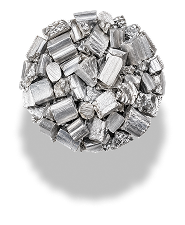
304 Stainless Steel
Mounting hardware and structural connectors in non-coastal environments. Good corrosion resistance at lower cost than 316. Widely specified for ground-mount hardware in inland and moderate-climate installations.
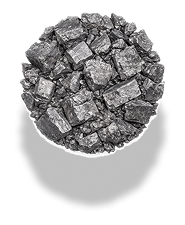
Carbon Steel (4130, 4140, 8620)
Structural connectors, foundation hardware, and gearbox components where strength-to-weight and cost are the primary drivers. Can be coated or galvanized for corrosion protection in outdoor applications.
17-4 PH Stainless Steel
High-strength fastener and connector applications requiring both corrosion resistance and mechanical performance above the capability of standard austenitic grades. Precipitation-hardened for elevated tensile and yield strength.
A356 Aluminum
Weight-sensitive mounting hardware and enclosure components where aluminum’s strength-to-weight ratio provides a design advantage over steel. Suitable for rooftop and floating solar applications where structural load is constrained.
MPC Capabilities for Solar Customers

Non-magnetic alloy expertise
MPC casts tracker pins, shafts, and bushings in non-magnetic 316 stainless steel, a critical specification for solar tracker systems that use magnetic encoders or sensor-based positioning. We maintain tight alloy composition control to meet magnetic permeability specifications.

Rapid prototype capability
3D-printed wax patterns allow new tracker or mounting component designs to be cast and evaluated in days, supporting fast product development cycles for solar hardware manufacturers and EPCs.
Tight tolerances as-cast
Investment casting tolerances of ±0.005 in/in reduce or eliminate post-cast grinding and machining on tracker components, lowering per-part cost and lead time.
Full secondary services
MPC coordinates CNC machining, heat treating, passivation, and protective coating, delivering finished components ready for installation rather than raw castings requiring additional processing.
Domestic manufacturing
All parts are manufactured in Milwaukee, WI. Domestic production eliminates international shipping lead times and simplifies supply chain compliance for US-based solar projects.
High-volume consistency
MPC’s ISO 9001:2015 quality system and robotic shell-dipping process ensure dimensional consistency across large production runs. This is an important aspect of solar projects where hundreds or thousands of identical tracker components must fit interchangeably in the field.
ISO 9001:2015 Certified
Every casting is produced and inspected under a documented quality management system certified by Intertek. Full traceability and documentation are available.
Frequently Asked Questions
Common Questions
Before Requesting
a Quote
What investment castings does MPC produce for the solar industry?

Why is non-magnetic stainless steel specified for solar tracker components?

What alloys does MPC cast for solar applications?

Can MPC produce solar tracker components at high volume?
Does MPC offer prototyping for new solar hardware designs?
What solar applications can MPC supply castings for?
What secondary operations does MPC offer for solar castings?
How do I get a quote for solar investment castings?
Get a Quote
Request a Precision
Casting Quote
Upload your drawings or project requirements and our engineering team will review your application — providing technical feedback, material recommendations, and competitive pricing.

Fast RFQ Response
Typical quote turnaround within 1–2 business days
Engineering Support
DFM review and casting optimization included with every quote
Scalable Production
Prototype to high-volume production capability
Full Technical Consultation
Material selection, tolerance review, and process recommendations